Key Takeaways
- AEM Guides solves documentation scale problems at the architecture level, not through workarounds
- DITA-native authoring, content reuse and conditional publishing work as a connected system, not a feature checklist
- Component-level translation sends only changed content to translators, cutting cost and turnaround time
- Browser-based review workflows produce audit trails that satisfy regulatory review obligations
- AI-assisted authoring improves as repository quality improves; architecture precedes AI value
- NetEffect’s global case study: 60% faster publishing cycles and 30% less authoring effort using AEM Guides
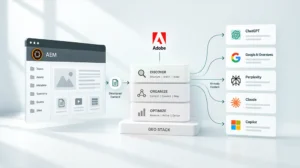
Enterprise documentation programs fail for predictable reasons. Content gets duplicated. Translations cost more than they should. Governance depends on people remembering things. Publishing to multiple channels means manual work that scales poorly. Adobe Experience Manager (AEM) Guides addresses each of these problems at the architecture level rather than through workarounds.
One framing point before the list. These features are most valuable as a system. Content reuse reduces translation volume. Translation efficiency makes multichannel publishing to more markets financially viable. Review workflows with version control produce auditable governance records. Planning this interdependency before configuration begins is what separates transformational implementations from functional ones.
1. DITA-Native Web Editor
The problem it solves: Technical writers switching between XML editors and content management systems lose time, introduce formatting errors and can’t collaborate with non-technical reviewers in real time.
AEM Guides provides a browser-based Web Editor built specifically for Darwin Information Typing Architecture (DITA) XML authoring. Authors work in a structured environment without needing to know XML syntax. The editor enforces DITA topic structure automatically. Concept topics stay conceptual. Task topics stay procedural. Reference topics stay factual.
What changes in practice: authors create structurally valid DITA without XML training, reviewers annotate directly in the browser without installing tools and formatting decisions are separated from authoring decisions. That separation is the foundation of all downstream reuse. Adobe Experience League documentation covers the Web Editor’s full authoring and publishing environment in detail.
2. Single Source Publishing to Multiple Output Formats
The problem it solves: Publishing the same documentation to a PDF manual, a web portal, an AEM Sites page and a mobile help system currently requires separate authoring or formatting work for each destination.
AEM Guides publishes from a single DITA source to multiple output formats simultaneously through configurable publishing presets. Source content is authored once. The publishing engine applies channel-specific transformation rules to produce each output without manual adaptation. As NetEffect’s analysis of multichannel publishing with AEM Guides explains, adding a new channel doesn’t add authoring work. It adds a publishing preset.
Output formats include PDF and print for technical manuals and regulatory submissions, HTML5 for web-based help systems and support portals, AEM Sites for customer-facing content integrated with marketing experiences, EPUB for mobile documentation and offline access, and JSON for headless and API-driven content delivery.
3. Content Reuse Through Conrefs and Keyrefs
The problem it solves: A safety warning, legal disclaimer or product specification appearing in forty documents requires forty manual updates every time it changes. Each missed update is a compliance risk.
DITA’s content reference mechanisms eliminate this problem architecturally rather than procedurally. A conref lets an author pull a fragment from one canonical topic into any other topic that needs it. When the content changes, the update happens in one place and propagates automatically everywhere the fragment appears.
Keyrefs work similarly for variable terminology. Product names, version numbers and market-specific language are managed centrally. Changing a key value in one file updates every instance across the entire content library. For enterprises managing compliance-critical documentation, this isn’t a convenience feature. It’s a risk management mechanism. NetEffect’s DITA 101 guide covers how this model reduces risk in regulated environments. A deeper look at conref and keyref implementation is available in NetEffect’s content reuse guide for AEM Guides.
4. Conditional Publishing and Profiling
The problem it solves: Maintaining separate documentation sets for different product variants, audience types or markets requires authoring the same base content multiple times with minor variations.
Conditional publishing in AEM Guides uses DITA profiling attributes to include or exclude content at the topic or element level based on defined conditions. A single topic set produces a beginner guide and an expert reference. Or a version for market A and a version for market B. One source replaces multiple parallel documentation branches, variant-specific updates happen in a single location and new variants are added by creating a new condition profile rather than duplicating content.
Translation volume also decreases. Only one source set requires localization rather than one per variant.
5. Translation and Localization Workflow
The problem it solves: In a document-centric environment, the entire document goes to the translator even when only a small portion has changed. Organizations pay for retranslation of content that was already approved.
AEM Guides manages translation at the component level. Only topics that have changed since the last cycle go to the translation provider. When integrated with a translation memory-enabled TMS, previously approved translations are reused automatically rather than retranslated.
The difference adds up quickly. Moving to a component-based translation workflow significantly reduces redundant translation volume and eliminates manual formatting effort across languages, as NetEffect’s analysis of structured content ROI illustrates. What used to take weeks per language takes days.
6. Review and Approval Workflows
The problem it solves: Documentation review cycles managed through email chains and shared drives have no audit trail, no deadline enforcement and no visibility into where content is in the approval process.
AEM Guides provides browser-based review workflows where every participant works in the same environment without exchanging files. Review tasks go to specific users with defined deadlines. Reviewers comment directly on topics. Authors respond and track resolution in the same interface. Multiple reviewers work simultaneously on different aspects of the same content.
Every review action is logged with a timestamp and user attribution. For enterprises with regulatory review obligations, the audit trail alone justifies the workflow investment. Demonstrating who reviewed what, when and what changed in response is a compliance requirement that email-based processes satisfy poorly.
7. Version Control and Baseline Management
The problem it solves: Publishing a specific version of documentation for a product release while continuing to develop the next version is difficult when content has no component-level versioning.
AEM Guides provides version control at the topic level. Every topic has its own version history. Changes are tracked, attributed and reversible. A baseline captures the complete state of a topic set at a specific point in time.
This matters most in two enterprise scenarios. First, regulatory submissions: documentation submitted for regulatory review must remain frozen exactly as submitted, even as development continues on the next version. Second, product release documentation: multiple product versions often share overlapping topics with release-specific variations, and baseline management lets each release reference the exact topic versions current at that release date.
8. AEM Assets Integration and Shared Asset Management
The problem it solves: Documentation teams maintaining a separate image and media library from the marketing team’s AEM Assets repository end up with two versions of every approved asset, maintained independently. Version inconsistency gets discovered only when a customer notices.
Because AEM Guides operates natively within the AEM repository, documentation and marketing teams share the same asset library. An approved product diagram on the marketing site is the same file referenced in the technical manual. When the asset updates in AEM Assets, both the marketing page and the documentation topic reflect the current version automatically.
That overhead, which grows with every product launch and every brand refresh, disappears entirely rather than just shrinking.
9. Content Search and Reuse Discovery
The problem it solves: Authors who can’t find existing content create new content. In a large DITA repository, duplicate topics inflate translation costs, introduce inconsistency and undermine the reuse model that justified the investment in structured authoring.
AEM Guides provides metadata-driven search across the entire content repository. Before creating a new topic, authors search by topic type, product, version, audience or review status. Search results surface existing topics that match the need, making reuse the path of least effort rather than the path of extra effort.
The reuse tracking capability adds a second layer. It shows where a topic is currently referenced across maps and outputs. Authors see the downstream impact of a change before making it. Administrators identify orphaned topics with no current references, candidates for retirement rather than indefinite maintenance.
10. AI-Assisted Authoring and Smart Suggestions
The problem it solves: Authors writing in DITA spend time on structural compliance checks, metadata tagging and terminology consistency that doesn’t add content value. These tasks slow down topic creation without improving content quality.
AEM Guides AI Assistant provides contextual suggestions within the Web Editor based on existing repository content. Smart suggestions recommend existing topics or fragments relevant to the content being authored, reducing duplication before it’s created. Content summarization condenses long reference material for secondary contexts. A text prompt feature lets authors edit or reformat selected content without manual rewriting. Metadata assistance suggests short descriptions based on topic content, reducing manual classification effort.
One critical point for enterprises evaluating AI features: AI in AEM Guides amplifies the quality of the content architecture it operates on. A well-structured DITA repository with clean metadata produces accurate and useful suggestions. A disorganized repository produces suggestions that require as much correction as manual authoring would have taken. The investment in content strategy pays additional dividends when AI capabilities are activated.
What This Looks Like at Scale
NetEffect implemented AEM Guides as part of a global content program for a professional services firm managing more than 180 websites across 150-plus markets. The combined effect of these features, operating as an integrated architecture rather than as independent tools, produced measurable results.
Publishing speed improved by 60% through automation and structured content reuse. Authoring effort dropped by 30%, freeing teams for higher-value work. Content consistency was achieved across 180-plus websites while regional teams retained the flexibility to adapt tone and messaging for local markets. Leadership gained real-time visibility into performance across all markets.
Every figure comes from NetEffect’s published case study on unifying 180-plus websites with AEM.
Features Deliver Through the Foundation Beneath Them
AEM Guides provides a genuinely capable set of enterprise documentation features. The ten covered here address the core operational challenges that make documentation programs expensive, slow and difficult to govern at scale.
The organizations that see strong outcomes treat AEM Guides as the execution layer for a strategy defined before the build began. Features are only as good as the information architecture, taxonomy and governance model they operate on.
If you’re evaluating AEM Guides or assessing why an existing implementation isn’t delivering expected returns, the NetEffect team can help you assess your environment and outline a practical path forward.
Frequently Asked Questions
AEM Guides provides DITA-native authoring, single-source multichannel publishing, content reuse through conrefs and keyrefs, conditional publishing, component-level translation, browser-based review workflows, topic-level version control, native AEM Assets integration, metadata-driven content search and AI-assisted authoring. Each feature addresses a specific operational problem that limits documentation velocity at enterprise scale.
AEM Guides sends only changed content components for translation rather than full documents, and when integrated with a translation memory-enabled TMS, reuses previously approved translations automatically. Language-specific outputs are generated through publishing presets without manual formatting effort. This component-level approach reduces translation costs and time to market as content volume grows.
AEM Guides AI Assistant provides smart suggestions, terminology checks and metadata tag recommendations based on existing repository content. The quality of its suggestions depends directly on the quality of the underlying content architecture. Well-structured repositories with clean metadata produce significantly more accurate suggestions than disorganized ones. Architecture investment pays AI dividends.
NetEffect works with global enterprises on AEM Guides implementations from content strategy through go-live. To discuss your documentation environment, get in touch.