Key Takeaways
- Success begins with an RFP that prioritizes business outcomes and technical scalability over mere feature checklists.
- Implementing AEM workflows and content governance early prevents the typical “content sprawl” that drains ROI post-launch.
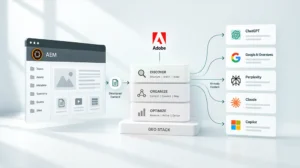
- Modern AEM implementations favor a composable tech stack, allowing enterprises to integrate best-of-breed tools without vendor lock-in.
- Building a reusable component library is the most effective way to reduce long-term development costs and ensure brand consistency.
- The “Go-Live” phase is not the finish line. Successful enterprises use data-driven debugging and performance monitoring to continuously refine the CX.
For a global enterprise, choosing Adobe Experience Manager (AEM) is a statement of intent. It signals a move toward customer experiences that actually work and content that scales. But here’s the thing: the gap between purchasing the license and achieving a successful “Go-Live” is often where the most ambitious digital transformations fall apart.
AEM implementation is not a “plug-and-play” exercise. It’s an intricate orchestration of technical architecture, content strategy and organizational change. To move from the Request for Proposal (RFP) to a high-performing production environment, enterprises must follow a rigorous, phase-based roadmap that prioritizes results over reports.
The Strategic RFP: Setting the Foundation
Most failed implementations can be traced back to a poorly defined RFP. If the initial document focuses solely on “features” rather than “outcomes,” the project risks scope creep from day one. An enterprise RFP for AEM must address the complexity of the existing ecosystem.
Before engaging AEM implementation partners, the organization must define its North Star. Are you solving for localized content delivery across 50 countries? Or are you focused on consolidating disparate legacy systems into a composable tech stack with AEM?
A successful RFP doesn’t just ask “Can AEM do this?” It asks, “How will AEM integrate with our existing PIM, CRM and ERP to drive a unified customer journey?” This clarity ensures that when you choose a partner, they’re aligned with your long-term business maturity, not just your immediate technical needs.
Discovery and Architectural Design
Once a partner is onboarded, the focus shifts to architectural integrity. This is where the “Define” and “Design” phases overlap. A common mistake at this stage is over-customization. AEM is powerful out of the box. The goal should be to use core features while building a scalable AEM component library for enterprise delivery.
Core Component Strategy
Enterprises should adopt a “Core Components first” mindset. By extending Adobe’s standardized components rather than building from scratch, you ensure better compatibility with future AEM version updates and reduce technical debt. This approach directly impacts AEM implementation costs. The more you stick to best practices, the lower your long-term maintenance burden.
Content Governance and Workflows
In an enterprise environment, content is created by hundreds of users across various departments. Without a strict roadmap for enforcing content governance with AEM workflows, the system quickly becomes a digital junkyard. Successful implementations design approval cycles, permission sets and automated metadata tagging during the design phase, not as an afterthought.
Development and Composable Integration
The development phase is where the vision meets reality. For the modern enterprise, “monolithic” is a dirty word. Today’s strongest Adobe AEM implementations lean into the composable nature of the Adobe ecosystem.
API-First Connectivity
AEM often serves as the hub of your Digital Experience Platform (DXP), but it shouldn’t be an island.
Whether you’re using AEM Sites for web delivery or AEM Assets for Digital Asset Management (DAM), the integration layer must be robust. Using a headless or hybrid approach allows your marketing team to create content once and deploy it across web, mobile and even IoT devices without duplicating effort.
Localization and Translation Best Practices
For global enterprises, the “Translation Integration Framework” within AEM is a critical success factor.
Best practices involve setting up “Live Copy” and “Language Copy“ roots early. Live Copy is part of AEM’s Multi Site Manager, which handles site structure and content inheritance across regions. The Translation Integration Framework works alongside it, managing the actual content translation workflows. Together they allow for a hub-and-spoke model where global brand standards are maintained at the center while local teams adapt content for cultural nuances without breaking the site’s architecture.
The Work Doesn’t Stop at Go-Live
A successful AEM implementation isn’t a single event. It’s a commitment. The organizations that get the most out of AEM aren’t the ones that crossed the finish line fastest. They’re the ones that treated go-live as mile one, not the last mile.
From a well-scoped RFP to a composable architecture built for the long haul, the pattern is clear: decisions made early ripple forward in ways that either compound your investment or quietly drain it. Content governance, component strategy, localization frameworks; none of these are details you bolt on later. They’re the scaffolding everything else rests on.
The good news? You don’t have to figure this out alone.
At NetEffect, our AEM experts have guided enterprises through every phase of this journey, from messy legacy migrations to full composable builds. If you’re planning an implementation, evaluating partners or just trying to untangle where your current setup went sideways, let’s talk.
Ready for a change? Chat with one of our AEM experts today to see how we can help you reach peak efficiency.
Frequently Asked Questions
It depends on scope, but most enterprise implementations run somewhere between six and 18 months from RFP to go-live. Factors like the number of legacy systems being integrated, the complexity of your localization needs and how much custom development you’re carrying all shift the timeline significantly.
Organizations that arrive with a clear North Star and well-documented requirements tend to move faster and spend less. The ones that treat discovery as optional usually learn why it isn’t.
Over-customization. AEM ships with a robust set of core components and a well-designed content framework. When teams bypass those in favor of building everything from scratch, they’re creating technical debt that shows up during every future upgrade. The better path is to extend what already exists, document every deviation and treat the component library as a living asset, not a one-time deliverable.
You can manage parts of it in-house, and many enterprises do. But the honest answer is that a hybrid model tends to work best. Internal teams bring institutional knowledge, business context and long-term ownership. A specialized AEM partner brings pattern recognition from dozens of similar implementations, which saves you from the kind of architectural mistakes that are expensive to undo. The RFP phase is actually the best time to think this through, because how you staff the project shapes every decision that follows.