Key Takeaways
- Modular Logic: A CCMS treats information as discrete assets, allowing precise updates without touching surrounding content.
- Architecture for AI: Structured data provides the semantic context that Large Language Models need to function accurately.
- Operational Fluidity: Decoupling content from its container lets teams launch products across global markets faster.
- Unified Governance: Centralized control ensures compliance and brand standards across every department.
Someone asks where the latest product spec is hiding.
Simple question, right? Not if answering it means opening four files, cross-referencing three versions and hoping nothing got missed along the way.
Scenarios like this play out in enterprises every single day. Technical manuals sit in FrameMaker. Release notes are buried in Word documents. API guides live in GitHub. Nobody planned it that way. Growth just made it happen. And now we’re paying the price in duplicated effort, inconsistent messaging and customers who find conflicting answers depending on where they look.
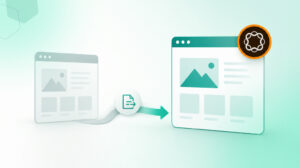
At its core, a Component Content Management System (CCMS) abandons the concept of a page. In a traditional setup, content is locked inside a document or web entry. In a CCMS, content lives as independent topics or components that can be assembled, reused and updated across any channel.
Adobe Experience Manager (AEM) Guides is a powerful, enterprise-grade component content management solution that enables native Darwin Information Typing Architecture (DITA) support in AEM, empowering it to handle DITA-based content creation and delivery.
Think of your product ecosystem as building blocks. A traditional CMS gives you a pre-built castle. Want to change one brick at the bottom? You have to tear the whole thing down. A CCMS gives you individual bricks and assembly instructions. Build a castle, bridge or tower using the same pieces. If a brick needs a color change, swap it once and every structure updates instantly.
From Page-First to Component-First Thinking
The primary reason enterprises feel stuck is the high cost of maintenance. When information is trapped in flat files, it becomes invisible to the rest of the organization.
The Traditional CMS Bottleneck: Content gets duplicated constantly. One team writes a product description for the web, another creates the same thing for the mobile app and a third rewrites it for the user manual. This creates Information Drift, where the app says one thing and the manual says another.
The CCMS Advantage: You establish a Master Component. Whether customers look at a help screen or a marketing landing page, they see the exact same verified data string.
For organizations that have managed an AEM migration to unify multiple sites, a CCMS is the tool that keeps those sites synchronized without increasing headcount.
Understanding DITA: The Language of Structured Content
DITA is the XML standard that AEM Guides uses to structure information. It treats content as a collection of core topics: tasks, concepts or references.
One of DITA’s main features is content reuse. It allows reuse from small phrases up to entire topics or maps. However, for content to be effectively reused, it must be well managed.
Because DITA is machine-readable and highly structured, it enables three key benefits:
Conditional Processing: Show different content to different users based on their role or product version.
Semantic Tagging: Add intelligence so search engines and AI models understand exactly what a piece of text represents.
Infinite Reusability: A single DITA topic can appear in a thousand different outputs without ever creating a duplicate file.
Single-Source Publishing: Write Once, Deliver Everywhere
In traditional environments, your technical writers create content for one channel. If the marketing team needs that same information for a landing page, they copy it. If support needs it for a knowledge base, they copy it again. Three versions of the same truth, all drifting apart over time.
AEM Guides flips this model completely. Authors create content using an easy-to-use web editor, then publish that same content to multiple outputs simultaneously. One source, many destinations.
The platform provides an omnichannel publishing experience to Experience Manager Sites, PDF, HTML5, EPUB, JSON, and custom output through DITA-OT.
Your marketing team shouldn’t need a developer ticket to update a banner. Your technical writers shouldn’t need to maintain fifteen different versions of the same safety warning.
Eliminating Hidden Friction in Global Scaling
When an enterprise expands into 20 languages, traditional CMS becomes an expensive liability. Translating a 500-page manual is a massive undertaking. CCMS environments enable translating only changed components.
AEM provides a Translation Integration Framework for DITA content, supporting both human and machine translation workflows.
Update 10% of a manual? Send only that 10% to your translation vendor. The system then reassembles the translated pieces into final documents automatically. This isn’t just about cost savings. It’s about velocity. Your localized support content can go live the same day as your product launch, rather than weeks later.
Governance as Strategic Enabler
In healthcare or aerospace, a manual mistake isn’t just a typo. It’s a liability. A CCMS provides active oversight by tracking every component’s lifecycle.
Before hitting publish, the system performs a “where used” check. It warns if that paragraph appears in 42 manuals and three websites. This prevents the ripple effect of errors that often occurs in fragmented systems.
In regulated industries like semiconductors or medical devices, an error in a manual is a compliance failure. By enforcing content governance through AEM workflows, organizations ensure that no topic is published without passing through rigorous review cycles.
The Business Case
Reduced Support Tickets: Structured content makes information significantly easier to find. When documentation integrates natively into AEM search, customers find answers faster and your support team handles fewer redundant inquiries.
Accelerated Time-to-Market: Product launches include unified documentation from day one. Publishing cycles can become 60% faster through automation and structured content reuse.
Future-Proofing for AI: Feed an LLM a 200-page unstructured PDF and it may hallucinate. Feed it structured XML and it understands hierarchy, context and the relationships between topics. Organizations implementing structured content today are building the training data for tomorrow’s AI support bots.
Architecting for the Next Decade
Pages are no longer the primary way we consume information. We consume answers. Tasks. Solutions.
A CCMS is the architectural response to this reality. By breaking content into reusable parts, you enable your enterprise to be more agile, more accurate and better prepared for whatever technology comes after AI.
If you’re ready to stop managing documents and start managing intelligence, contact Net-Effect today.
Frequently Asked Questions
A Headless CMS separates content from the presentation layer. A CCMS goes further by breaking the content itself into reusable components using standards like DITA. This distinction becomes essential for complex technical documentation where single paragraphs might appear in dozens of different outputs.
Not necessarily, but it does require refactoring. AEM Guides includes ingestion tools that can convert legacy formats like Word or FrameMaker into DITA XML.
Absolutely. While technical writers were early adopters, marketing teams increasingly use CCMS for product descriptions, legal disclaimers, and fine print that must stay consistent across thousands of pages.
If you’re already in the Adobe ecosystem, AEM Guides lives natively within your CMS, sharing assets, users and permissions. It provides a single CMS for managing marketing and technical content end-to-end.